 Binary Cipher
Explain how AEP turns governed signals into usable profiles.
Trace XDM, schemas, datasets, ingestion, identity evidence, merge policies, audiences, and destinations as one chain of contracts.

The AEP Operator Academy.
Clear foundations. Production depth. No vendor spin. Learn to explain, design, validate, and operate Adobe Experience Platform as a connected system—not a collection of screens.
No payment is accepted from this release preview. Follow AEP release updates through the Binary Cipher newsletter.
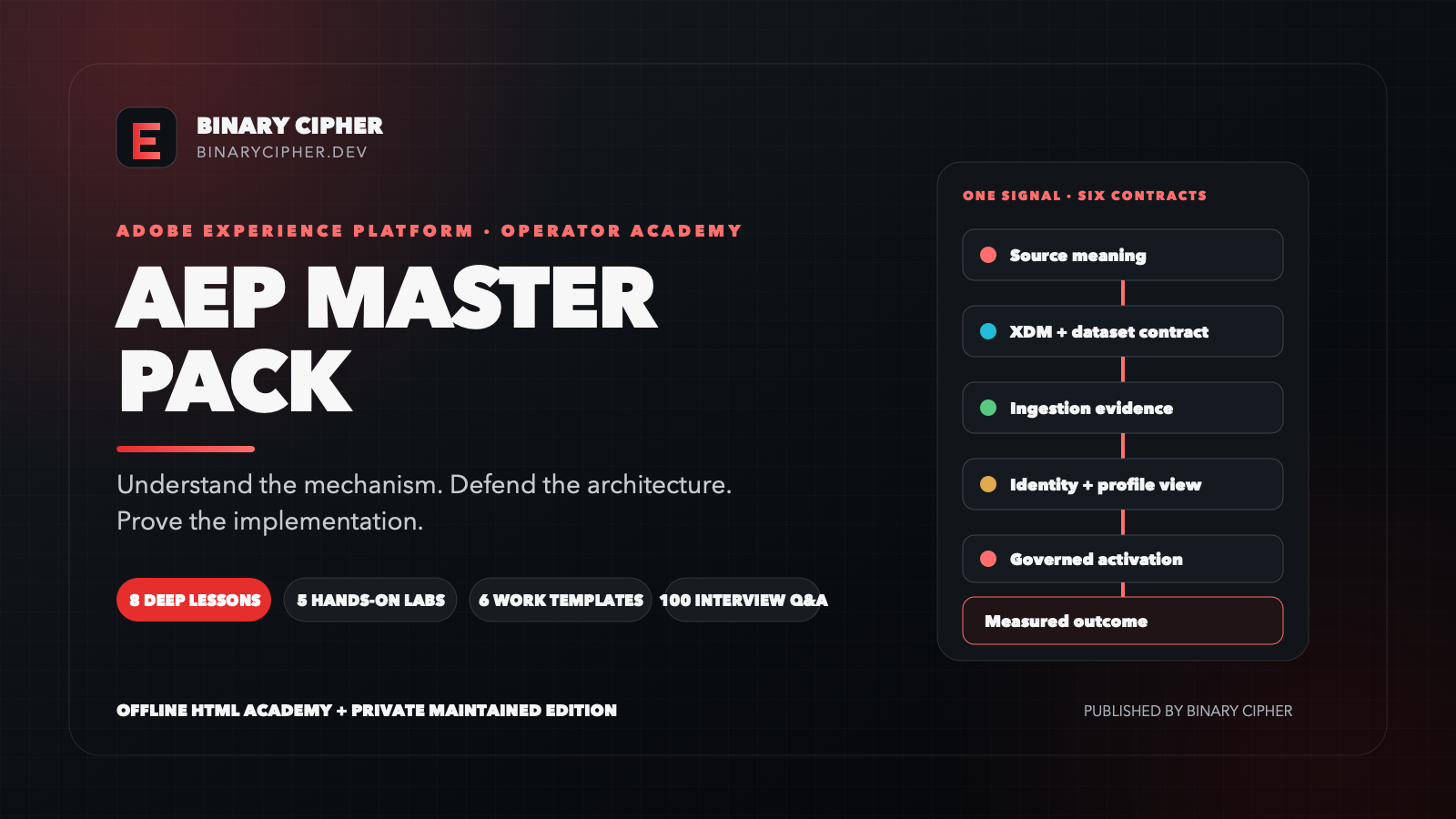
Each part asks you to explain the boundary, trace the mechanism, build an artifact, and defend the choice. That is the difference between recognizing a product term and being able to operate the platform.
Trace XDM, schemas, datasets, ingestion, identity evidence, merge policies, audiences, and destinations as one chain of contracts.
Work through cardinality, latency, profile eligibility, consent, data minimization, guardrails, ownership, and lifecycle tradeoffs.
Use validation checkpoints, observability questions, APIs, runbooks, and recovery patterns instead of clicking through menus and guessing.
Use the field notes to remember the mental model, the sticky board to prepare a working session, and the system map to trace one signal from collection to activation.
Showing AEP field notes.
XDM is the agreement. A schema names the fields; the dataset receives records. Decide what a field means, who owns it, and how long it should live before ingestion starts.
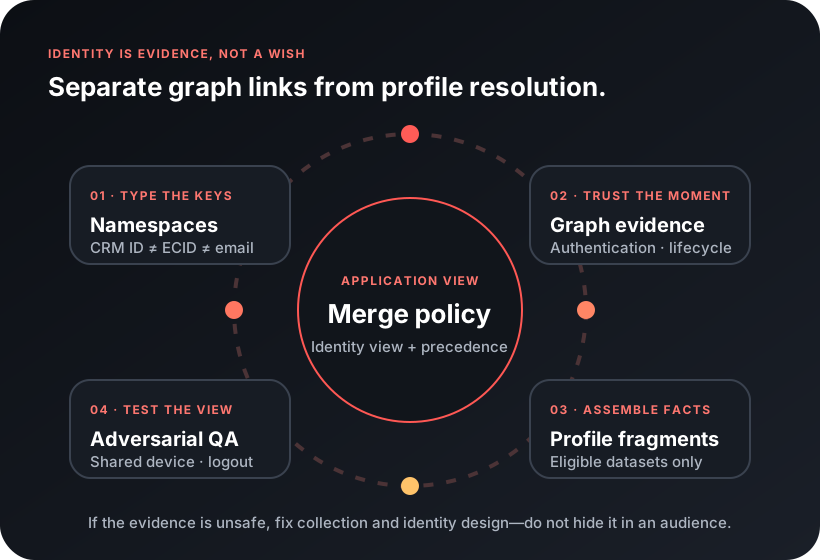
A namespace gives an identifier meaning. The primary identity on a record is not a ranking of the customer—it tells AEP which identity to use when that record enters the graph.
Profile is a governed, merged view used by downstream services. A merge policy answers a business question; it is not a universal truth about the person.
An audience is only useful when its evaluation method, destination contract, consent rule, and refresh expectation agree. Validate the handoff—not just the audience count.
Margin check → If a team cannot name the owner and the validation evidence, the design is not ready.
Best for: the first architecture conversation, interview preparation, and explaining why AEP is a chain of governed contracts.
Name the signal, its source, expected latency, and the decision it should support.
Confirm namespace meaning, identifier quality, collision risk, and graph behavior with test profiles.
Keep a known record and trace it through schema validation, dataset ingestion, graph, profile, audience, and destination.
Assign ownership for schema changes, namespace approval, consent enforcement, audience QA, and destination failures.
Enable only fields and datasets that serve a clear profile, segmentation, personalization, or governance need.
Know how to stop ingestion, disable activation, isolate a bad field, and communicate the customer impact.
Best for: discovery workshops, implementation planning, design reviews, and the launch-readiness wall.
The platform becomes understandable when each stage has an input, an owner, a validation check, and a downstream expectation.
Best for: debugging. Start at the first checkpoint where expected evidence disappears; do not begin at the destination and guess backward.
Every number below comes from the shared hosted/offline content source, so the sales promise can be checked against the product that ships.
A serious foundations route plus production-depth architecture and operations.
Beginner, intermediate, and architect answers with mechanisms, examples, and failure patterns.
Create reviewable evidence for schemas, identity, ingestion, governance, and operating decisions.
Downloadable working artifacts for planning, review, QA, decisions, and handoff.
Scenario drills plus a separate mock assessment without invented Adobe exam weights.
Primary Adobe documentation mapped to the implementation questions it answers.
Start with platform foundations and finish with enterprise operation. The order makes dependencies explicit, but every lesson also works as a maintained reference.
The current curriculum adds the capabilities and operating questions practitioners now encounter in real implementations, while keeping every time-sensitive claim tied to an official Adobe source.
Five guided labs and six reusable templates turn reading into architecture evidence. A 30-day plan connects the lessons, interview bank, certification scenarios, references, and artifacts into a practical sequence.
Follow a signal from collection and XDM validation through datasets, identity, profile, audience evaluation, and activation.
Create schema, namespace, merge-policy, governance, observability, and decision artifacts with explicit owners and evidence.
Use 100 interview answers, 50 scenario drills, and a separate mock assessment to expose fuzzy boundaries before a review or exam.
The same delivery architecture already used by the Binary Cipher Starter Vault has been adapted for a paid product, with a separate paid tier, private access, stable deep links, replay protection, and revocation controls.
Gumroad delivers a self-contained ZIP with local navigation, responsive dark-mode pages, diagrams, labs, templates, progress, manifest, license, support path, and token-free links to the latest online lessons.
A customer-specific private URL activates a signed browser session. The hosted edition carries corrected references, current 1.x curriculum, lesson progress, working tools, and stable lesson-level access without putting bearer tokens in analytics.
Planned launch price: $99 for 14 calendar days. The exact end timestamp and timezone will be shown before checkout can open.
This release preview is not for sale. Follow AEP release updates through the Binary Cipher newsletter; it is a general publication, not a product-specific waitlist.
Follow AEP release updates Questions? support@binarycipher.devNo. This is independent practitioner education from Binary Cipher. It builds the platform reasoning and scenario judgment that support implementation work and certification study. Adobe controls its exam names, objectives, policies, and credentials; always verify the current official exam guide.
No. The foundations route is for serious learners who need a clean mental model. The advanced route, labs, decision templates, operating guidance, interview bank, and architecture scenarios are designed for working practitioners, consultants, and solution architects.
The purchase includes a versioned offline HTML academy delivered by Gumroad and customer-specific access to the maintained hosted edition on BinaryCipher.dev. While the purchase license remains active, the offline academy works without a private URL or internet connection.
All corrective and curriculum updates in the AEP Master Pack 1.x line are included while the purchase license remains active. Binary Cipher may price a future major edition separately, and will describe that boundary before release.
The individual license is for one named purchaser across their own devices. It does not permit redistribution, resale, shared team drives, or using the materials as a client-training product. A five-seat team license is planned at $399.
Proposed policy: The original purchaser may request a full refund within 14 calendar days of purchase by emailing support@binarycipher.dev from the purchase address and including the Gumroad order number. A timely, good-faith request that identifies the purchase is eligible; there is no minimum product-usage requirement. After refund, hosted access is revoked and the license to retained offline copies ends; delete those copies. Non-waivable consumer rights still apply. The policy remains a review draft until Binary Cipher approves launch; no payment is accepted in the current review state.
Built and supported by Binary Cipher. Independent of Adobe. Adobe Experience Platform and related marks belong to Adobe.